
What a Gang Mold Is, and How Panel Output Is Actually Calculated
Elastoquip's 12-Panel Gang Mold casts 12 fence panels per cast. Learn how to calculate real daily precast panel output from cycle time and crew size.
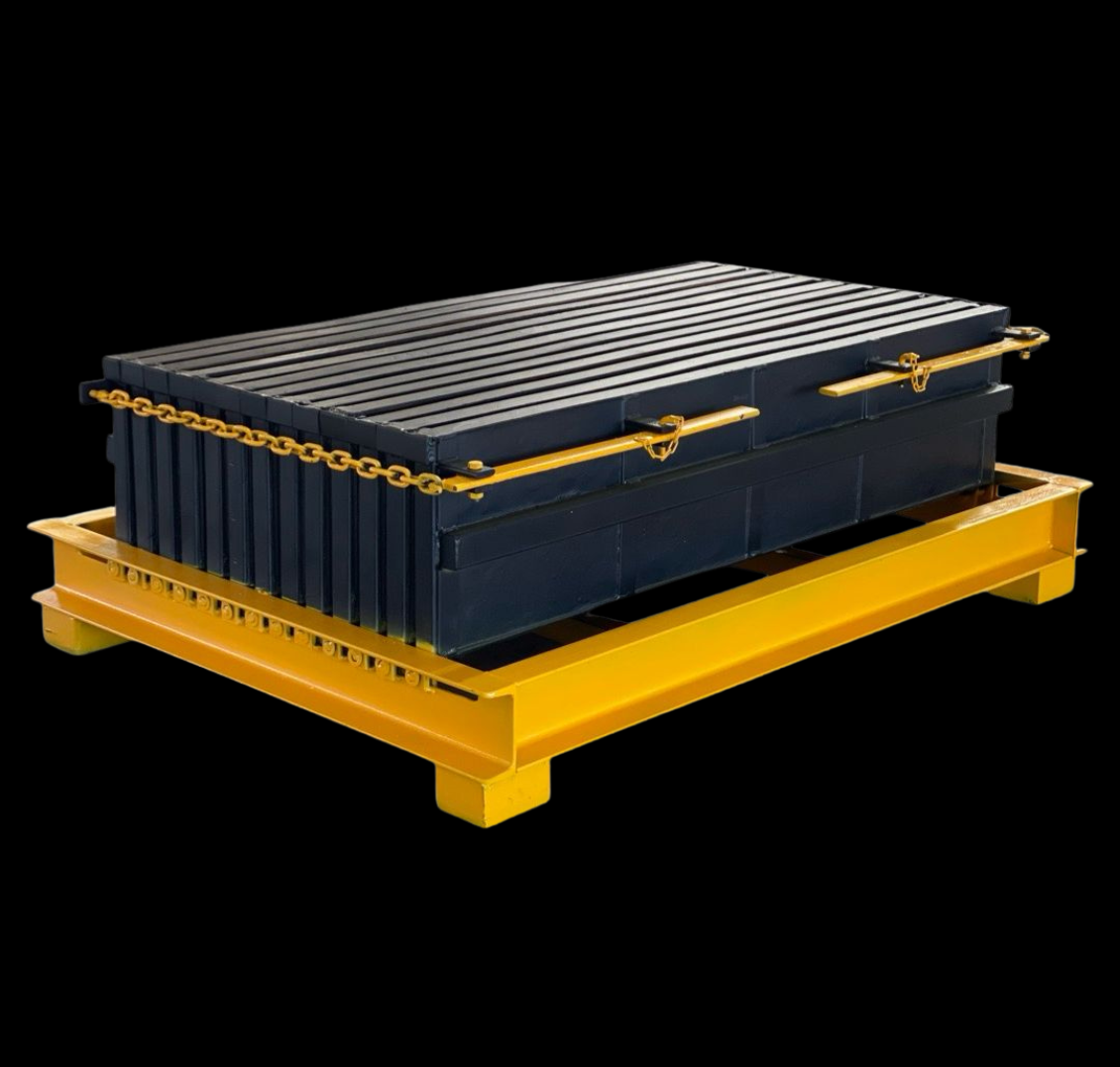
A gang mold casts many identical units in a single pour, and Elastoquip's 12-Panel Gang Mold casts 12 fence panels per cast. That is the fixed part of the equation. Daily output is a separate calculation: panels per cast multiplied by the casts your plant completes in a shift, where casts per day is governed by cure time before demolding, crew size, demold and reset time, and how many mold sets you run. The mold determines the first number. Your process determines the second, and no mold manufacturer can honestly quote it for you.
What a gang mold is
A gang mold is a single mold system with multiple cavities that are filled, cured and stripped as one unit. The operator sets up once, pours once, cures the whole set together, and demolds the whole set together. The output of that operation is a batch of identical panels rather than a single panel.
The alternative is individual forms, where each panel is its own setup, pour and strip cycle, so handling, release agent and alignment checks repeat for every unit produced.
Ganging spreads the fixed labour of a cycle across the whole batch instead of charging it to each panel. In one cycle you get:
- One setup and alignment step, not one per panel
- One pour and consolidation sequence
- One cure window covering the whole batch
- One demold and reset operation
- One dimensional standard applied to every panel in the set
The anchor number: 12 panels per cast
The Elastoquip 12-Panel Gang Mold casts 12 precast concrete fence panels per cast. That figure is a property of the mold and does not change with your crew, your mix or your weather. It is the only output number here that belongs to Elastoquip rather than to your plant.
What you get in each of those 12 panels is set by how the mold is built. Elastoquip molds are proprietary high-grade urethane encased in a steel framework, combining fine texture reproduction with dimensional stability. They are liner-free and fully self-contained, so there is no separate liner to align or replace, and they are double-sided, so both faces of every panel carry sharp texture. The full range is on the mold systems page.
The output formula
Daily panel output comes from one piece of arithmetic:
panels per cast × casts per day = daily panel output
Run more than one mold set and the formula applies per set, with the results added. The two terms behave very differently, and that is where output planning usually goes wrong.
- Panels per cast is fixed and published. For the 12-Panel Gang Mold it is 12.
- Casts per day is not a property of the mold. It is a property of your plant.
- Mold sets multiply the whole result, because one set can be filling while another cures.
Why curing is usually the real constraint
A mold is unavailable from the moment concrete enters it until the panels are demolded. That window is set by cure behaviour, not by the mold. Until the concrete reaches the strength your procedures require for stripping and handling, the mold cannot be turned around, however quickly it releases.
This is why casts per day is yours to establish. It depends on mix design, ambient conditions, whether you use any form of accelerated curing, and the strength gate your quality control sets before demolding. Two plants with identical molds can land on very different daily figures.
Mold design still contributes at the edges. Liner-free construction means fast demolding and less maintenance between cycles, which shortens the strip-and-reset portion of the cycle. It does not shorten the cure. Standard precast mixes work with these molds, so no special mix is adding time to your process either.
Worked example: inputs you supply, not claims we make
The numbers below are illustrative. Every input marked ASSUMED is a figure the reader supplies from their own plant data. None are Elastoquip specifications and none should be treated as a guarantee.
ASSUMED inputs, yours to establish:
- ASSUMED: your quality control permits demolding after a cure period that fits twice into your working day
- ASSUMED: your crew can strip, clean and reset the mold within the gap between those two pours
- ASSUMED: you operate one 12-Panel Gang Mold set
- ASSUMED: handling and storage can absorb the batch as it comes off the mold
Feed those assumptions through the formula and change one of them to see how far the answer moves. The mold is identical in all three lines below; only the cure gate and the number of sets differ.
- One mold set, cure gate allows two casts per day: 12 × 2 = 24 panels per day
- Two mold sets, same cure gate: 12 × 2 × 2 = 48 panels per day
- One mold set, cure gate allows one cast per day: 12 × 1 = 12 panels per day

How to increase precast panel output
Once you can see which term is limiting you, the levers become obvious. If casts per day is capped by cure, adding crew will not help. If it is capped by strip and reset time, a faster-releasing mold will. The realistic levers, roughly in order of effect:
- Add mold sets so one batch cures while another is poured
- Shorten the cure gate through mix design or accelerated curing, within your own quality standards
- Reduce demold and reset time, where liner-free construction helps directly
- Size the crew to the pour and strip peaks rather than to the average
- Clear downstream bottlenecks in handling, stacking and yard space, which quietly cap output at the same point every day
Sizing a line before you buy
Bring three of your own numbers to the sizing conversation: the cure period your quality control accepts before demolding, the time your crew needs to strip and reset, and the panel volume your contracts require weekly. Those settle how many mold sets you need. Panels per cast is already known.
Elastoquip provides guidance on mold setup, concrete mix recommendations and best-practice production, and builds steel moulds for precast concrete where a part needs maximum rigidity rather than fine texture. Panel appearance is a separate decision from output: the fence design range covers brick, stone, woodgrain, ledgestone, smooth and ranch rail without changing the arithmetic above.
To have the calculation checked against a production target, get in touch with your cure and cycle assumptions and we will work through the mold configuration with you.
Frequently asked questions
How many fence panels can a gang mold produce per cycle?
Elastoquip's 12-Panel Gang Mold produces 12 precast concrete fence panels per cast. That figure is fixed by the mold and does not vary with crew or conditions. Daily output is a different question, because it depends on how many casts your plant completes per day.
What is a gang mold?
A gang mold is a single mold system with multiple cavities that casts many identical units in one pour, rather than casting each unit in its own individual form. The whole set is filled, cured and demolded together, so one setup and one cure window serve the entire batch. This spreads the fixed labour of a production cycle across every panel in the set.
How many precast panels can I cast per day?
Daily output is panels per cast multiplied by casts per day, so with a 12-panel gang mold it is 12 multiplied by the number of casts you complete. Casts per day is set by your cure time before demolding, your demold and reset time, and your crew size, which is why no supplier can quote a universal daily figure. Measure those inputs in your own plant and run the multiplication.
What usually limits precast panel output, the mold or the process?
In most plants the curing method is the real constraint rather than the mold, because the mold is unavailable from the pour until the concrete reaches the strength required for stripping. Liner-free mold construction shortens the demold and reset portion of the cycle but does not shorten the cure itself. Adding mold sets, so one batch cures while another is poured, is usually the most effective way to raise the daily number.
Does a gang mold need a special concrete mix?
No. Standard precast mixes work with Elastoquip molds, and no special mix is required to get the texture off the mold surface. Elastoquip can recommend ideal aggregates and strengths if you want the mix matched to your cycle targets.
Talk to our team
Send us your panel design, production volume and cycle targets and we will recommend a mold configuration and concrete mix to match. Or browse the full mold system range and fence designs.
Contact Elastoquip