
What Equipment Do You Need to Produce Precast Concrete Fence Panels?
A functional setup guide for new precast fence producers: casting bed, mixing, molds, vibration, reinforcement, curing space, lifting and yard storage.
Producing precast concrete fence panels takes nine functions rather than nine machines: a level casting area, batching and mixing capacity, the mold system itself, a way to consolidate the concrete, reinforcement handling, curing space, demolding and lifting, storage for cured panels, and transport. Scale changes the equipment, not the list. Thinking in functions matters because these items are not equally decisive: curing and yard space quietly set the ceiling on output, and the mold system determines what you can actually sell.
The nine functions every fence panel operation has to cover
Map the sequence a panel goes through before pricing anything: batched, placed, consolidated, cured, stripped, lifted, stored, shipped. If one step has no equipment behind it, production stops there.
- Casting area — a rigid, level, drained surface with working room around every mold.
- Batching and mixing — capacity to fill a mold in one continuous pour, plus material handling.
- Mold system — panel molds plus post, cap and rail tooling, because a fence is a system.
- Consolidation — form-mounted, table or immersion vibration to drive concrete into the texture and release air.
- Reinforcement handling — cutting, bending and repeatable positioning of mesh or bar at the correct cover.
- Curing — protected space and a method to hold panels while they gain strength.
- Demolding — release agent, a consistent stripping method, and lifting points or clamps.
- Lifting and yard storage — lifting capacity matched to your heaviest part, and racked storage for cured stock.
- Transport — trailers and A-frame or flat racks that get panels to site undamaged.
The casting area: level, drained and larger than expected
The casting bed is the least interesting item on the list and the one most likely to cost money later. A mold sitting on a surface that is out of level, or that deflects under load, casts panels that are out of plane — which shows up as stepping and uneven gaps once a run of fence is installed.
A workable casting area needs a rigid, level slab that will not settle; clearance around each mold for a crew to set steel, pour, screed and strip; drainage and a wash-down point, because wet cast work produces slurry and cleaning molds is a daily job; and lighting and weather protection suited to your climate. If you intend to produce year-round, a roof matters more than most first-time producers assume.
Batching and mixing
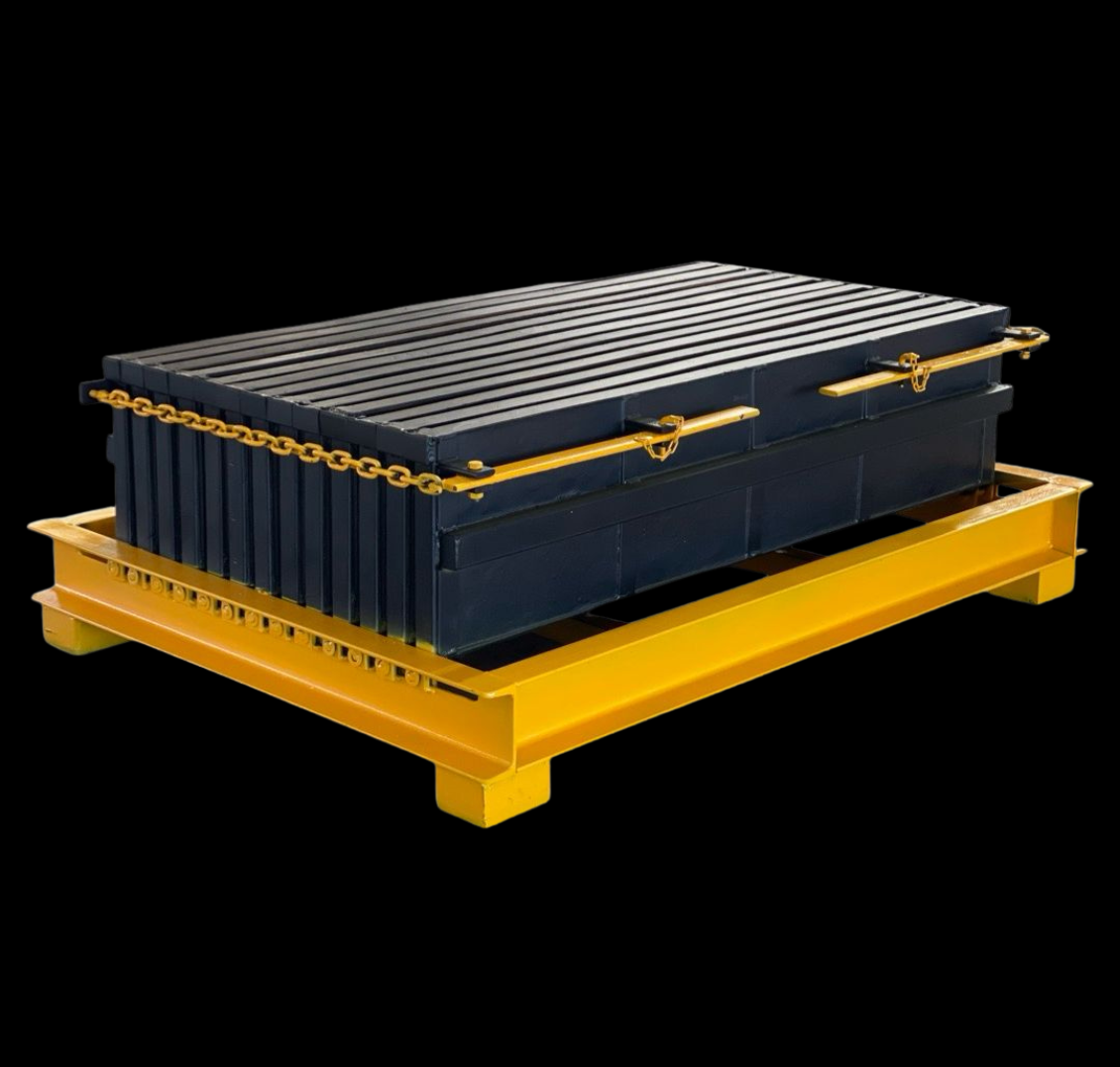
Mixing capacity has one hard requirement: you must be able to place a full mold in a single continuous pour, so no cold joint forms partway up a panel. That scales with the mold — a gang mold casting several panels at once needs the batch, the crew and the placement method planned around filling the whole set. Elastoquip's 12-Panel Gang Mold casts 12 panels per cast.
The mix itself is less exotic than people expect. Standard precast mixes work with Elastoquip molds, and no special mix is required; Elastoquip can recommend ideal aggregates and strengths for the part and texture you are producing. What matters at setup is repeatability, because a wet cast texture is only as consistent as the batch behind it.
Consolidation: getting concrete against the mould face
Consolidation is what transfers the mould surface onto the concrete. Wet cast production depends on the mix flowing into the fine relief of the mold face and on air escaping before it sets. Without adequate vibration you get bug holes, blurred texture and honeycombing along edges and returns, all visible on a finished fence at close range.
Options run from form-mounted external vibrators to a vibrating table under the mold to hand-held immersion vibrators in smaller operations. All work when matched to the mold and the mix, and over-vibration segregates the mix as surely as under-vibration leaves voids. Elastoquip provides guidance on mold setup, mix recommendations and best-practice production alongside the tooling.
Reinforcement handling
Panels, posts and rails are structural elements, so reinforcement is a function with its own equipment rather than an afterthought. You need dry storage for mesh and bar, a way to cut and bend to size, and a repeatable method — jigs, chairs, spacers — of holding steel in position while the pour and the vibration happen.
Cover is the detail that gets missed. Steel that drifts toward the face during consolidation will eventually stain and spall the panel, which on a decorative fence destroys the appearance you paid for. Elastoquip's Panel Rail Mold is made to tight tolerances with reinforcement alignment in mind, but the jigs and spacers are yours to standardise.
The mold system determines what you can sell
Everything else on this list is capacity. The mold is product. Texture, panel dimensions, whether one face or both are finished, and how quickly you can strip are properties of the mold rather than of your plant, so the mold decision should be made before the rest of the setup is sized.
Two things are worth settling at purchase. The first is whether both faces are finished: Elastoquip molds are double-sided, producing sharp realistic texture on both faces of every panel and on all sides of posts, rails and caps, which matters because a fence is looked at from both sides. The second is construction. Elastoquip molds are proprietary high-grade urethane encased in a steel framework, liner-free and fully self-contained, so there is no separate liner to buy, align or replace. Where a part needs maximum rigidity instead, the same team builds steel moulds for precast concrete, across eight fence designs covering brick, stone, woodgrain, ledgestone, smooth and ranch rail.
Then the oversight. The most common planning mistake is buying panel molds only, then discovering at the first installation that there is no tooling for the parts that hold the panels up. A complete fence is a system of panels, posts, caps and rails. Elastoquip's range covers the 12-Panel Gang Mold, a Post & End Post Mold, a Post Cap Mold and a Panel Rail Mold, with line, corner, T and end post configurations. Plan the full system at the start.
Curing space is the constraint that sets your real output
Curing is where new producers are most consistently wrong about their own capacity. A panel occupies space for the whole period between being cast and being strong enough to handle, stack or ship. Multiply the panels you intend to cast per day by the days each must stay put, and you have the minimum footprint your yard has to absorb. That arithmetic, not mixer size, is what caps most small operations.
Curing method is a real choice: covered ambient curing, moisture retention with sheeting or a curing compound, or accelerated methods using heat. Each trades capital against turnaround, and faster turnaround buys back space. Duration varies with mix, temperature, method and the strength a part must reach before it is moved, so agree targets with your mix and mold advisors rather than guessing.
Demolding, lifting, storage and transport
Demolding is where finished panels get damaged, and the equipment is modest: release agent, a consistent stripping technique, and lifting hardware or clamps suited to the part. Speed here is largely a property of the mold; Elastoquip describes its liner-free construction as giving faster setup, less maintenance and fast demolding, which feeds straight into how many casts a day a mold supports.
Lifting should be specified from your heaviest part, not your average one. Work out panel and post weights from your dimensions and mix, then size forklift, telehandler, gantry or crane capacity from that figure. Storage and transport are separate line items from curing: cured inventory needs stable racked yard space, and delivery needs trailers with A-frame or flat racks and tie-downs.
Decide the tooling before the yard: tooling sets the product, the yard sets the rate. The molds for precast concrete overview is a starting point for that decision.
Frequently asked questions
What equipment do I need to start producing precast concrete fence panels?
At minimum you need a level casting area, mixing capacity able to fill a mold in one continuous pour, the mold system itself, a means of consolidating the concrete such as form-mounted or immersion vibration, reinforcement handling, protected curing space, lifting equipment sized to your heaviest part, and yard storage plus transport for cured panels. Scale changes the equipment used for each function but never removes a function. The mold system is the item that determines what you can actually sell, so decide it first.
How much space does a precast concrete fence operation need?
There is no universal figure, because the footprint is driven by curing rather than by casting. Estimate it by multiplying the panels you intend to cast per day by the number of days each panel must stay in place before it can be handled or shipped, then add the casting area, mold storage and separate yard space for cured inventory. Curing and storage space, not mixing capacity, is what usually caps output for a new producer.
Do I need a special concrete mix for precast fence panels?
No. Standard precast mixes work with Elastoquip molds and no special mix is required. Elastoquip can recommend ideal aggregates and strengths for the part you are casting and provides guidance on mold setup and best-practice production; day to day, what matters most is batching the same mix the same way every time, since a wet cast texture is only as consistent as the batch behind it.
Do I need separate molds for fence posts, caps and rails?
Yes. A complete precast fence is a system of panels, posts, caps and rails, so panel molds alone will not produce a sellable fence, and forgetting the other tooling is the most common planning mistake new producers make. Elastoquip makes a Post & End Post Mold, a Post Cap Mold and a Panel Rail Mold alongside panel gang molds, with line, corner, T and end post configurations for different positions in a run.
How many panels can I produce per day?
Daily output depends on cycle time, crew size and curing method rather than on any single machine. Elastoquip's 12-Panel Gang Mold casts 12 panels per cast, but how many casts you complete in a day is governed by how quickly panels can be stripped and by how much curing space is available to hold them afterwards. Plan realistic output backwards from your curing footprint rather than forwards from mixer capacity.
Talk to our team
Send us your panel design, production volume and cycle targets and we will recommend a mold configuration and concrete mix to match. Or browse the full mold system range and fence designs.
Contact Elastoquip