
Precast Concrete Fence vs Wood, Vinyl and Masonry
Is a precast concrete fence worth it? An honest comparison with wood, vinyl and masonry on lifespan, upkeep, cost, sound, fire, looks and installation.
A precast concrete fence is usually worth it if you plan to keep the same fence for decades and care most about low maintenance, sound blocking and fire resistance; it is usually not worth it if you need the lowest price this year, want to install the fence yourself, or expect the layout to change. Concrete costs more up front than wood, the panels are heavy enough to need equipment and a skilled crew, and a cheaply made panel looks obviously fake. In return it lasts far longer than wood or vinyl, resists weather, fire and impact, blocks sound, and needs almost no upkeep.
What a precast concrete fence actually is
Precast means the concrete is cast at a plant, not poured at your property. Panels, posts, rails and caps are cast in reusable molds, cured under controlled conditions, then trucked to site and set into grooved posts. Masonry, by contrast, is laid unit by unit on site with mortar.
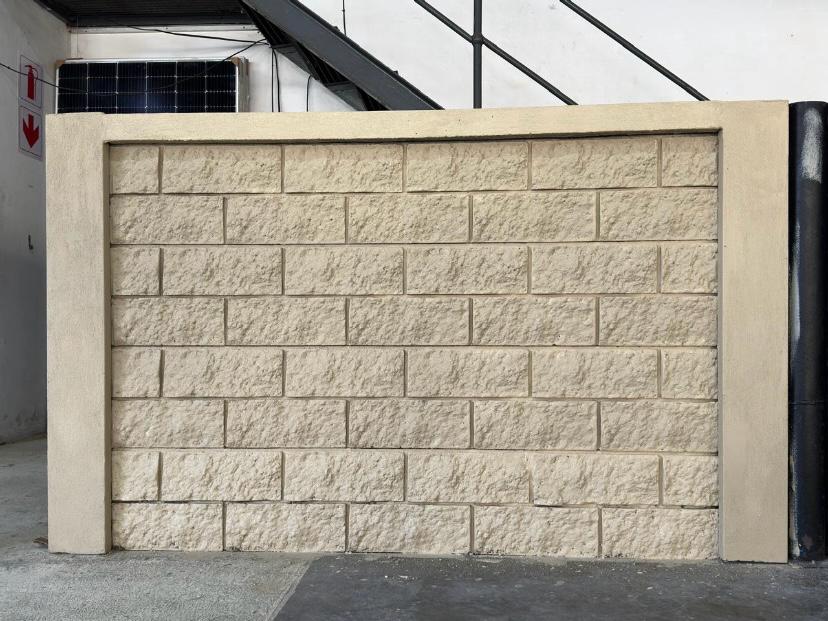
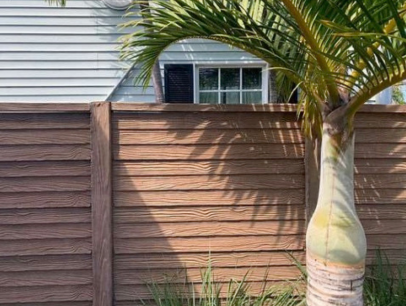
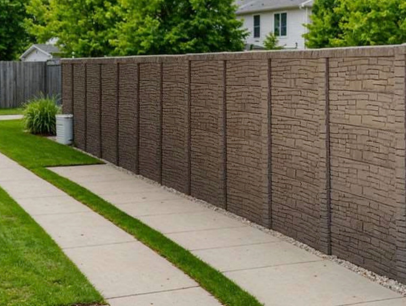
The practical consequence: the quality of a precast fence is decided at the plant, in the mold, long before anything reaches your property. Modern panels are structural and decorative at once, cast with realistic stone, brick, woodgrain or smooth faces rather than left as bare grey slabs.
Concrete, wood, vinyl and masonry side by side
Each of these materials is the right answer for someone. Each row gives one material its genuine advantage and its genuine drawback.
- Wood — Pro: lowest upfront cost of the four, easy for a homeowner to build, simple to cut in a gate or change a run later. Con: much the shortest-lived option, because it rots, warps, greys and attracts insects, and it needs sealing or staining on a repeating schedule.
- Vinyl — Pro: very little upkeep, no painting, no rot, and a DIY-friendly install. Con: a thin hollow product, so it does almost nothing for sound, it cracks on impact and in hard cold, it grows brittle with UV exposure, and damaged sections are replaced rather than repaired.
- Masonry (block or brick) — Pro: the look many buyers actually want, real mass for sound and fire, and a very long life on a correct footing. Con: built one unit at a time on site, so it is the slowest to erect, its price swings with mason availability, and mortar joints eventually need repointing.
- Precast concrete — Pro: lasts far longer than wood or vinyl, resists weather, fire and impact, blocks sound, needs almost no maintenance, and uniform panels go up quickly and read as one consistent, upscale line. Con: higher upfront cost than wood, panels heavy enough to need lifting equipment and a skilled crew, little scope for DIY, and awkward to modify once set.
How long does a concrete fence last?
Longer than wood or vinyl, by a large margin rather than a marginal one. That is as precise as anyone should be without knowing your panel design and your climate, and you should be wary of a supplier who quotes an exact number of years without asking those questions first.
The difference is in the failure mode. Wood fails biologically: it takes on water, rots at the ground line, feeds insects, and the boards cup and split. Vinyl fails chemically, as UV works on the polymer and cold makes it brittle. Concrete does none of that, though it can still fail on undersized footings or from poorly placed reinforcement — which is why the producer matters more than the material category.
Upfront price versus lifetime cost
Concrete loses the upfront comparison against wood, and does not need to pretend otherwise. Its case is a lifetime-cost case, best understood as a concept rather than a number, because real figures swing hard with local labor rates, panel design and how long you hold the property. Total cost is four things added up over decades, not one invoice.
- Installed price — what you pay to get the fence standing. Wood is normally lowest; concrete and masonry highest.
- Recurring maintenance — staining, sealing and replacing rotted boards for wood; cleaning and repointing for masonry; washing for vinyl. Precast concrete needs almost none, which is where its lifetime-cost advantage comes from.
- Repairs after damage — storms, vehicle impacts, fallen limbs. Lighter materials take more damage per event.
- Replacement — the big one. A material you replace once or twice during your ownership has quietly cost you two or three installed prices, plus the disruption.
Sound, fire and impact
This is where the gap between concrete and the light materials is widest, and it usually decides the question for homes backing onto a busy road. Sound blocking is a function of mass and of gaps: a solid precast panel has plenty of mass and no gaps between boards, so it blocks sound in a way a hollow vinyl panel or a board fence cannot. How much quieter your yard gets depends on panel thickness and design, wall height and the geometry between you and the noise source, so ask about your specific panel rather than trusting a general figure.
Fire is more clear-cut. Concrete resists fire; wood is fuel and vinyl deforms. In wildfire-exposed areas that is the whole conversation, and worth checking against local code. For impact, concrete and masonry shrug off hits that flatten a wood or vinyl run, and a damaged precast panel can often be lifted out and swapped.
Appearance, and when concrete looks fake
This is concrete's most real weakness, and it deserves stating bluntly: a poor-quality precast panel looks obviously fake. The tells are shallow texture that reads flat from the sidewalk, an identical pattern repeating down the run, mismatched color between batches, and a plain untextured back face facing your neighbor.
None of that is inherent to concrete; it is a symptom of worn or low-detail tooling. Panels cast in well-made molds carry crisp stone, brick and woodgrain detail straight off the mold surface, and double-sided molds texture both faces, so the fence looks finished from the street and from inside the yard. For the styles and surface treatments available, see our guide to decorative concrete fence designs, and browse the full texture range.
Installation: the honest drawbacks
A wood or vinyl fence is a weekend project for a capable homeowner. A precast concrete fence is not. The panels are heavy, so setting them normally means a telehandler or boom truck, site access for that equipment, and a crew who have set precast before. Footings and post spacing have to be right the first time, because correcting them later is a demolition job.
Modification is the other honest drawback. Adding a gate, moving a run for a new driveway, or stepping the wall down an unplanned slope are straightforward in wood and awkward in concrete. The upside: because components arrive finished, the on-site portion of a precast job is short compared with masonry, which is built unit by unit on site.
So is a precast concrete fence worth it for you?
Choose precast concrete if you plan to hold the property a long time, if you are an HOA or developer needing one consistent boundary treatment across many lots with no owner-by-owner upkeep burden, if you are dealing with road noise, or if fire exposure is a real concern. Choose wood or vinyl if upfront budget binds, if you want to do the work yourself, or if the layout is likely to change.
If precast is the right fit, your next step is a precast producer in your region, not a mold supplier. Elastoquip builds the fence molds and steel moulds those producers cast panels in, so we do not sell fences to homeowners — but knowing what good tooling produces tells you whose wall to buy. Ask which molds a producer runs and whether their panels are textured on both faces, then compare the available fence textures so you can ask for what you want by name.
Frequently asked questions
Is a precast concrete fence worth it compared to wood or vinyl?
A precast concrete fence is worth it if you plan to keep the fence for decades, because it lasts far longer than wood or vinyl, resists weather, fire and impact, blocks sound, and needs almost no maintenance. It is not worth it if the upfront budget is your main constraint, since concrete costs more to install than wood, or if you want a fence you can put up and change yourself. The tradeoff is a higher price now against far lower upkeep and replacement cost later.
How long does a concrete fence last?
A precast concrete fence lasts far longer than a wood or vinyl fence, because concrete does not rot, feed insects, burn or grow brittle with UV exposure the way those materials do. No responsible supplier should quote an exact number of years without knowing your panel design, reinforcement, footings and climate. Service life depends heavily on how well the panels were cast and how well the fence was installed, so the producer you choose matters as much as the material.
What are the pros and cons of a concrete fence?
The pros of a concrete fence are long service life, resistance to weather, fire and impact, effective sound blocking, almost no maintenance, and a uniform upscale appearance across a long run. The cons are a higher upfront cost than wood, panels heavy enough to require lifting equipment and an experienced crew, very limited scope for DIY installation, and difficulty modifying the fence later to add a gate or change a run. A poorly made precast panel also looks obviously artificial, so quality varies between producers.
Does a concrete fence block noise better than a wood fence?
Yes. Sound blocking depends on mass and on the absence of gaps, and a solid precast concrete panel has far more mass and no board gaps compared with a wood or hollow vinyl fence. How much quieter a given yard becomes still depends on panel design and thickness, wall height, and the distance and geometry between the yard and the noise source, so ask the producer about the specific panel you are considering rather than relying on a general figure.
Can I install a precast concrete fence myself?
Generally no. Precast concrete fence panels are heavy enough that setting them normally requires lifting equipment such as a telehandler or boom truck, site access for that equipment and the delivery truck, and a crew experienced in keeping a precast run plumb and level on correctly sized footings. Wood and vinyl fences are far better suited to homeowner installation, and that ease of DIY is one of their genuine advantages over concrete.
Talk to our team
Send us your panel design, production volume and cycle targets and we will recommend a mold configuration and concrete mix to match. Or browse the full mold system range and fence designs.
Contact Elastoquip