
Precast Concrete Fencing for HOAs and Residential Subdivisions
How HOA boards and developers evaluate precast concrete perimeter fencing: uniformity, reserve budgeting, sound, storm damage and the real tradeoffs.
For most HOAs and residential subdivisions, a precast concrete panel fence is the strongest perimeter option available — provided the association is prepared to spend more at installation in exchange for a long service life with almost no recurring maintenance, and has the site access to set heavy panels. The case for concrete is not that it is cheap on day one. It is that a board buys the fence once, controls exactly how it looks, and largely removes it from the annual maintenance argument.
What follows is for the board member or developer who has to justify that decision to homeowners.
What an HOA is actually buying when it buys a perimeter fence
A perimeter fence is not the same asset as a backyard fence, and confusing the two is where most HOA fencing disputes begin. The run along an arterial road, around the entry, or behind a greenbelt is usually association property: the HOA specifies it, insures it, repairs it and gets blamed for it. Fences between lots normally belong to the homeowners.
The board question is therefore not "which fence is cheapest" but "which fence can we specify once and still afford, and still like, three boards from now." Precast concrete answers that well: every panel cast from the same mould is visually identical, so the standard is set by the tooling rather than by the crew or whichever contractor won a phase.
The decision criteria that actually matter to a board
Boards argue about price first and everything else later, which is backwards. These are the criteria that decide whether a fencing choice is still defensible in ten years:
Score every candidate material against all eight. Wood and vinyl usually win the first line and lose most of the rest.
- Upfront installed cost, including site access and equipment.
- Recurring maintenance burden, and which budget line it comes out of.
- Visual consistency across the run, and the ability to match it years later.
- Sound attenuation, if any of the boundary faces an arterial road.
- Fire, wind and impact resilience against local hazards.
- Vandalism and graffiti exposure on street-facing faces.
- Repairability — whether one damaged section can be replaced alone.
- Enforceability — whether the standard can be written into the governing documents.
Why uniformity matters more to an HOA than to any homeowner
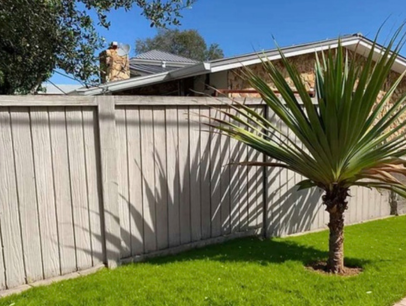
Uniform perimeter fencing matters to an HOA because the boundary is read as one continuous element rather than as a series of individual fences: a run that is consistent along its full length reads as a maintained community, while the same run in mismatched sections reads as a neglected one, no matter how well any single section has been kept.
That is the failure mode of leaving perimeter fencing to individual owners. Homeowners replace panels in different years, with different lumber, stain and height. Each replacement is defensible on its own; the cumulative result, from the road, is a patchwork, and the patchwork is what buyers and appraisers see. A cast panel system removes that variable.
Reserve funds and lifecycle budgeting
Precast concrete moves fencing spend out of the operating budget and into the capital and reserve budget. A wood perimeter is a permanent recurring expense: staining, board replacement, post resets, storm repairs, and eventually a full replacement cycle landing on some future board. Concrete is a larger one-time expense with a modest reserve line behind it. Precast needs almost no maintenance, which is what lowers its lifetime cost.
Recurring maintenance also gets deferred when budgets are tight, and deferred fence maintenance is highly visible. What nobody can honestly give you is a national cost-per-foot figure, because delivered price depends on the local producer, haul distance, panel height and site access. Get installed quotes from regional producers on your actual run, then have your reserve specialist model concrete against wood over the same study horizon.
Sound, fire and storm along the boundary
Subdivisions backing onto an arterial road have a specific problem: traffic noise in rear yards. Solid concrete panels block sound in a way a wood fence with gaps and shrinkage cracks does not. If that is a driver for your community, ask the producer whether the specific panel has been tested and request the data rather than accepting a general claim — thickness, height and installation detail all affect the result.
The resilience case is simpler. Precast concrete resists weather, fire and impact. A non-combustible perimeter is a meaningful line in a wildfire hazard assessment, and in high-wind regions panels seated in reinforced posts behave very differently from wood that lifts and scatters. Confirm wind loading and footing design for your site and code.
Vandalism, graffiti and replacing one panel instead of a run
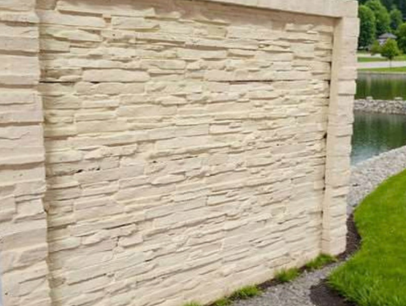
Street-facing walls attract graffiti. Concrete is not damaged by paint-removal methods the way wood is, and textured faces such as stone and ledgestone break up the flat surfaces taggers prefer. Anti-graffiti sealers are common on exposed runs.
Boards routinely underestimate the repair story. In a typical precast fence, panels stack into slotted posts rather than being fastened into a continuous structure. When a vehicle takes out a section, the damaged panel is lifted out and a replacement dropped into the same posts — one panel, not a whole run, and because it comes from the same mold system it matches. That is a very different insurance and reserve conversation than rebuilding wood.
Developers: set the standard early, phase by phase
For a developer the strongest argument is sequencing. A subdivision built out in phases needs phase four to look like phase one, and site-built fencing drifts as crews and subcontractors change. Panels cast from the same mold system do not, so a boundary completed years apart still reads as one wall.
Setting the standard at platting is far easier than retrofitting it. Once fence type, texture and height are in the design guidelines and CC&Rs before the first lot closes, every buyer purchases into a defined perimeter. Introducing that standard into an established neighbourhood means a special assessment, easement agreements and a vote, which is why so many older subdivisions keep the patchwork. Choose the texture with the long view: browse the precast concrete fence designs available, and see our guide to decorative concrete fence panels for how individual patterns differ.
The honest drawbacks, and how to move forward
The honest tradeoff is that precast concrete fencing costs more to buy and install than wood or vinyl and requires equipment and an experienced crew to set, and in exchange the association gets a perimeter that is consistent, hard to damage, and effectively absent from the annual maintenance budget.
Three drawbacks deserve saying plainly. Installation logistics are real: panels are heavy, trucks must reach the alignment, and setting them takes lifting equipment and a crew who has done it before. Quality varies enormously, and a cheap precast panel looks obviously fake — a shallow pattern with a visible repeat fools nobody and becomes what homeowners complain about, the real reputational risk for a board buying on price alone. And availability is regional, because freight is expensive and options depend on which producers operate near you.
So start with the boundary, not the product: map the runs the association owns, note which face traffic, then ask regional precast producers for installed quotes and references. Elastoquip does not sell or install fences — we manufacture the double-sided molds and steel moulds for precast concrete that producers use to cast these panels, posts, rails and caps. Producers being asked for a fence line can start with our mold systems.
Frequently asked questions
What is the best fence for an HOA or subdivision?
For most HOA and subdivision perimeters, precast concrete panel fencing is the strongest overall choice because it is uniform, needs almost no maintenance, blocks sound, and resists weather, fire and impact. The tradeoff is a higher upfront installed cost and the need for lifting equipment and an experienced crew. Wood and vinyl are cheaper to install but require ongoing maintenance and become visually mismatched as sections are replaced at different times.
Why does uniform perimeter fencing matter to an HOA?
An HOA perimeter is seen from the road as one continuous element, so consistency along the whole run signals a maintained community while mismatched sections signal a neglected one. When individual homeowners replace fence sections at different times with different materials and finishes, the boundary becomes a patchwork the association cannot easily correct. Cast concrete panels avoid this because every panel comes from the same mold and matches, including replacements made years later.
How should an HOA budget for a concrete perimeter fence?
Precast concrete shifts fencing from a recurring operating expense into a capital item with a modest reserve line for occasional damage, instead of an annual cost for staining, repairs and eventual replacement. Because delivered price depends on local producers, haul distance, panel height and site access, there is no reliable national cost-per-foot figure. Get installed quotes from two or three regional precast producers on your actual fence run and have your reserve specialist compare materials over the same study period.
Can a single damaged concrete fence panel be replaced?
Yes. In a typical precast fence the panels stack into slotted posts rather than being fastened into one continuous structure, so a damaged panel can be lifted out and a replacement set into the same posts. Because replacement panels are cast from the same mold system, the repair matches the rest of the run instead of standing out as a patch.
Do precast concrete fences look artificial up close?
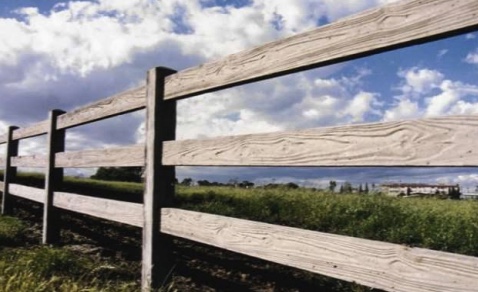
It depends entirely on the quality of the mold used to cast them. A well-made panel reproduces fine stone, brick or woodgrain detail directly off the mold face and is convincing at close range, while a cheap panel with a shallow pattern and an obvious repeat looks plainly artificial. Before an HOA approves a supplier, board members should inspect installed work in daylight both from the road and at arm's length.
Talk to our team
Send us your panel design, production volume and cycle targets and we will recommend a mold configuration and concrete mix to match. Or browse the full mold system range and fence designs.
Contact Elastoquip